API & MCP
Connect your tools to GenticFlow.
Use the REST API to connect your existing software, scripts, and workflows. Connect AI clients and PSA agents through MCP. Both can read device data, manage tickets, investigate problems, and run the endpoint actions you allow.
Included with Hero. Compare Plans
What you can do
The same operations, through MCP or REST.
Start with read-only access to inventory and diagnostics. Add ticket updates or endpoint actions when a connection needs them. Available operations always depend on its permissions.
Find endpoints and inventory
Look up devices, connectivity, assigned sites, and the last collected hardware and software inventory.
Ask and investigate
Ask a read-only question about a connected endpoint or start a background investigation and retrieve its findings.
Read live diagnostics
Inspect processes, services, installed applications, updates, user sessions, and event logs.
Keep tickets up to date
Create tickets, update status and assignments, read conversations, and add findings as comments or internal notes.
Manage alerts, organizations, and sites
Review monitoring alerts, close or reopen them, and manage organizations and their sites. For MSPs, organizations are customers; both use the same API operations.
Take permitted endpoint actions
Restart a service, install updates, or restart a device when the connection has those specific rights.
MCP for AI clients and agents
MCP (Model Context Protocol) gives AI clients and agents a defined set of GenticFlow tools. Work from a chat client, or connect a compatible AI technician in your PSA to investigate devices and carry out permitted actions.
REST for scripts and integrations
Use a versioned JSON API to read inventory, manage tickets, retrieve investigations, and run permitted actions from your own software.
ChatGPT example
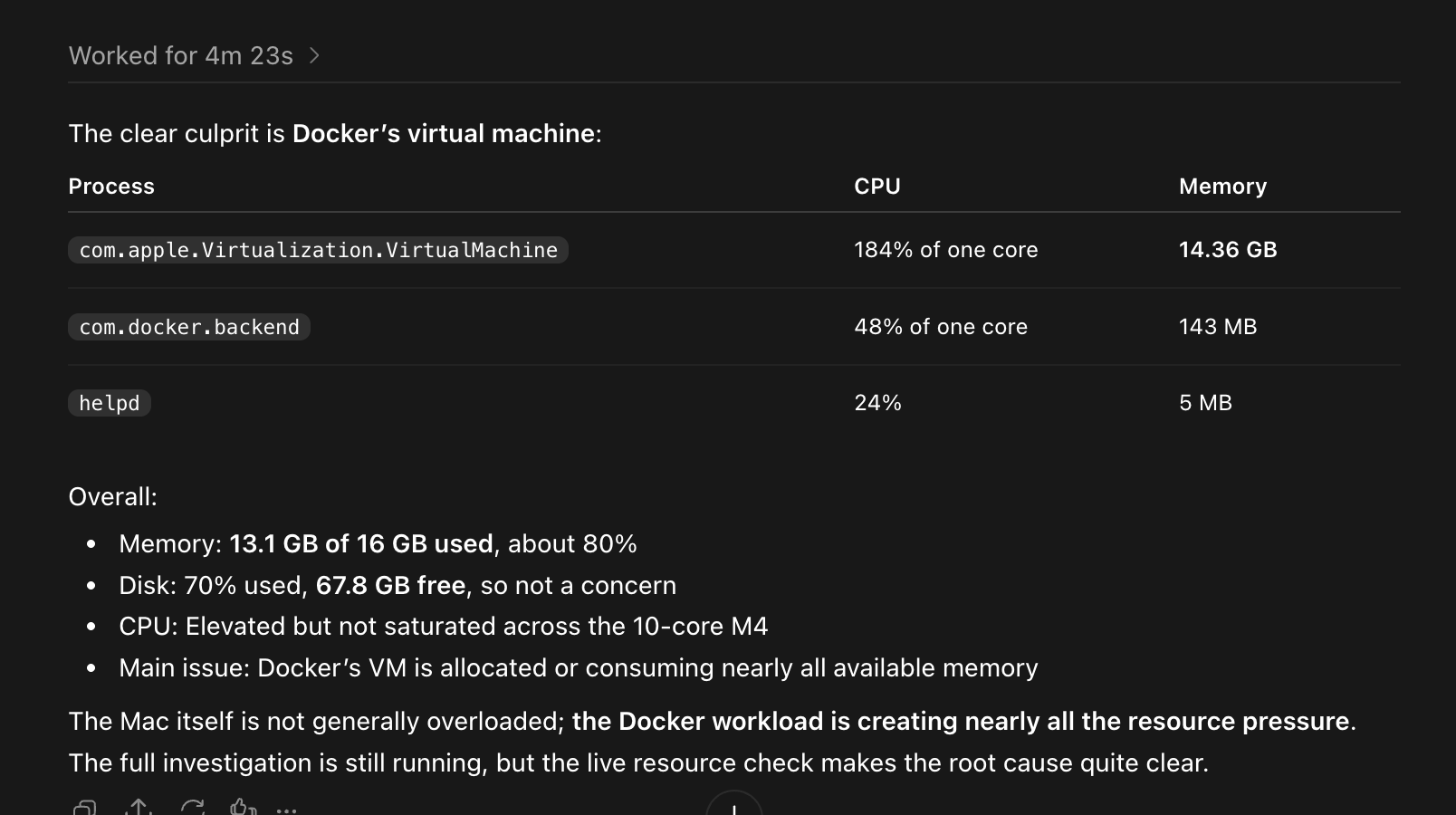
Investigating resource usage
In this ChatGPT conversation, a technician asked GenticFlow to investigate resource usage. The response used live process and system data to highlight Docker's virtual machine as a major resource consumer, while the background investigation continued.
The request
“Investigate what takes the most resources on that Mac mini.”
Choose your client
Guided setup in GenticFlow for these clients, plus compatible custom MCP clients.
- ChatGPT
- Claude
- Claude Code
- Codex
- Hermes
- OpenClaw
- Custom
Agent-to-agent workflows
Your PSA agent coordinates. GenticFlow investigates and acts.
An AI technician in your professional services automation (PSA) system can use MCP to ask GenticFlow to investigate a device, collect the findings, and prepare work for a technician to approve. Your PSA keeps the ticket and approval process; GenticFlow provides the endpoint tools.
The agents gather evidence
The PSA agent identifies the affected endpoint and asks GenticFlow to run read-only diagnostics or an investigation. It retrieves the findings for the ticket.
A technician reviews the plan
The PSA agent presents the evidence and proposed action, including the target device. Its workflow waits for the technician's decision before requesting changes.
GenticFlow runs the permitted action
After approval, the PSA agent calls an allowed MCP tool, such as restarting a service. It checks the result and can request a follow-up diagnostic before updating its ticket.
This is a workflow you can build with a compatible PSA agent. The PSA or agent workflow must enforce technician approval before sending action requests. GenticFlow checks permissions on every request; it does not add a separate approval step for MCP actions.
Examples to build
Print jobs are stuck
Investigate the Windows Print Spooler service and relevant event logs. If a restart is justified, the PSA agent asks a technician to approve the interruption. GenticFlow restarts the service; the agent checks its state and asks the user to try printing before marking the ticket resolved.
A Windows device is missing updates
Check available updates and installation history. The PSA agent presents the exact updates for technician approval, then asks GenticFlow to install the approved set. It checks installation outcomes and pending reboot status, and brings any required restart back for approval.
A workstation is barely responding
Ask GenticFlow to inspect process CPU and memory use. If one process is responsible, the PSA agent presents the evidence and a proposed stop, including the risk to unsaved work. After technician approval, it requests that specific action, rechecks resource use, and records whether the slowdown remains.
Build with the REST API
Read device data. Update tickets. Run actions.
Find a device, retrieve its inventory, start an investigation, and add the findings to a ticket. Use API keys with assigned roles or OAuth access tokens. Read data as JSON, with pagination for resource lists such as endpoints, tickets, and alerts.
Your deployment's interactive OpenAPI documentation lists the supported operations, required rights, inputs, and responses.
Find Your API Docscurl --get "https://YOUR-GENTICFLOW-HOST/api/v1/endpoints/" \
--header "Authorization: Bearer $GF_API_KEY" \
--data-urlencode "search=mac mini"Replace the host with your GenticFlow address and set GF_API_KEY to your stored API key. The response lists matching devices you can access. Use a returned device ID in subsequent calls.
Access you control
Choose what each connection can do.
Choose each connection's rights
Give each application only the operations it needs. API keys also follow their assigned role; OAuth connections follow the signed-in user's permissions and access scope.
Added OAuth rights need consent
Adding application rights does not expand an existing OAuth connection. The user must consent again. Removing rights reduces access on subsequent requests.
Review the activity
See API and MCP requests in the application's Activity section. Endpoint commands and Ask requests also leave records in Command Audit.
Revoke access when needed
Revoke an API key, remove an MCP client, or disable the application. Optional IP restrictions provide another access boundary.
Get connected
Set it up in API & MCP Access.
On Hero, open Settings and choose API & MCP Access. If it is not visible, ask your administrator to check deployment availability and your permissions.
Create an application
Name the connection, choose its access rights, and save. Reopen it from the application list. Use separate applications for integrations with different responsibilities.
Choose MCP or API
In MCP Clients, choose Connect Client and follow its setup guide. For REST, have an administrator open API Keys and create a key with the appropriate role.
Connect and review
API & MCP Info has your URLs and API Docs link. Review access during OAuth sign-in, then check the application's Activity after your first request.
FAQ
API & MCP questions
Connection options, permissions, and what you need to get started.
Which plan includes API and MCP access?
API and MCP access are included with Hero, through the Automation module. They are not included with Smart. Your deployment must have API access enabled, and an administrator or authorized manager configures applications and their rights. API key creation requires an administrator.
Which AI clients can I connect?
GenticFlow provides setup guides for ChatGPT, Claude, Claude Code, Codex, Hermes, OpenClaw, and a Custom option for other compatible MCP clients. The guide explains the sign-in and configuration needed for the selected client. Client-side availability can depend on your account and workspace settings.
Does the AI client get unrestricted endpoint access?
No. MCP lists only tools allowed by the connection's effective permissions, and every call is authorized again. Ask and investigations use read-only diagnostics. Mutating tools, such as restart or uninstall, can execute when their rights are granted; use a read-only application if you only want diagnostics.
Can a PSA agent wait for technician approval?
Yes, if the PSA or agent workflow implements that approval step. It can gather findings through MCP, show the proposed action to a technician, and send the action request after approval. GenticFlow checks the connection's permissions but does not require a separate confirmation for each MCP action. This is a workflow to build with a compatible agent, not a built-in approval flow or a ready-made integration with every PSA.
Where do I find the API documentation?
Open Settings, API & MCP Access, then your application and API & MCP Info. The API Docs link opens the interactive reference for your deployment, including request and response schemas and each operation's required rights. The same section provides the API base URL and MCP connection URL.
Do live diagnostics require the GenticFlow agent?
Yes. Live endpoint checks and investigations require a connected GenticFlow agent and the applicable permissions. Cached inventory can be read while an endpoint is offline. Ask and investigations use your configured AI model and are subject to the applicable model allowance.
Is this the same as connecting external MCP servers to GenticFlow?
This page covers external clients connecting to GenticFlow. The separate MCP Servers feature lets GenticFlow's own agents use tools from other services. Both are available with Hero.